A ger in Mongolia is the country’s traditional dwelling. a round, portable felt-and-wood tent that nomadic Mongolian families have lived in for centuries. In the West it’s usually called a “yurt,” but the Mongolian word is ger (pronounced roughly “gair”), and on a trip across Mongolia it’s likely where you’ll be sleeping most nights. We spent three weeks in August-September 2018 looping through Mongolia by hired driver. Ulaanbaatar to the Gobi to Tsenkher Hot Springs to White Lake and up to Khovsgol Lake. and stayed in a different ger almost every night. This is what they’re like inside, what’s it like to stay in one, and how to plan a ger camp stay of your own.
*This post may contain affiliate links, as a result, we may receive a small commission (at no extra cost to you) on any bookings/purchases you make through the links in this post. As an Amazon Associate, we earn from qualifying purchases. Read our full disclosure
This 2026 first-hand guide covers what a ger actually is, how a ger differs from a yurt, what’s inside, what to expect at a Mongolia ger camp, the camps we stayed at across the Gobi and central Mongolia, and our honest tips for booking one.
Staying in a Ger in Mongolia at a Glance
| What it is | Traditional Mongolian round felt-and-wood tent; “yurt” in the West, ger in Mongolian |
| Where you find them | Across rural Mongolia (Gobi, central highlands, northern lakes) plus tourist ger camps near major sights |
| Best season to stay | June through September. the only window when most ger camps are open |
| Comfort level | Tourist camps: proper beds, wood stove, shared bathroom block. Family camps: shared living, simpler beds, more cultural exchange. |
| What to expect inside | Central wood stove, low beds along the walls, sacred altar opposite the door (which always faces south) |
| Our regions | Gobi Desert · Tsenkher Hot Springs · Terkhiin Tsagaan (White) Lake · Shine-Ider · Khovsgol. all August/September 2018 |
| How to book | Most travellers book a multi-day Mongolia tour that includes ger camps in the itinerary. independent ger-camp booking is hard outside Ulaanbaatar |
| Best for | Anyone visiting Mongolia. gers are essentially the only realistic countryside accommodation |
What Is a Ger?
A ger is the traditional Mongolian dwelling: a round, portable home with a wooden lattice frame, wooden roof poles meeting at a central crown ring, walls made from layered wool felt, and a canvas outer shell to keep the rain out. The whole structure assembles in about two to three hours by an experienced family and packs onto pack animals (or now a truck) for the next move.
The Mongolian word is ger, and it literally means “home” or “dwelling.” Mongolian nomadic families still live in gers year-round across the countryside. not as a heritage thing, but because gers genuinely work better than any alternative for a population that moves with the seasons. In the cities (Ulaanbaatar especially), entire neighbourhoods called “ger districts” surround the central core, where rural-to-urban migrants keep their gers as permanent housing.
Ger vs Yurt. Are They the Same?
Essentially yes, with regional naming differences. Yurt is the Turkic/Russian word for the structure and is the term that filtered into English via Central Asia. Ger is the Mongolian word for the same kind of dwelling. and the Mongolian version has some distinct features worth knowing about:
- The Mongolian ger door always faces south (for winter sunlight and Buddhist tradition).
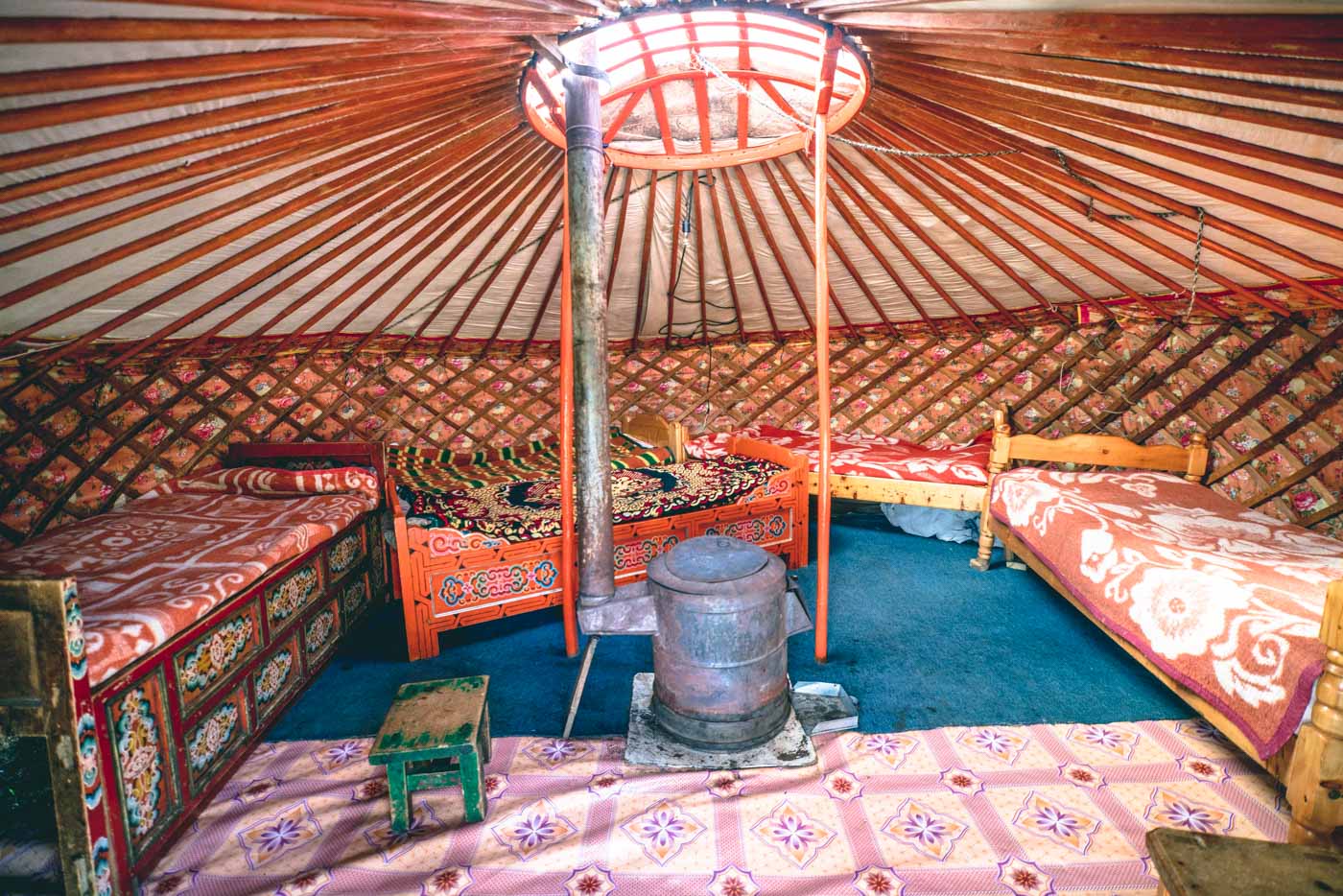
- The wooden frame is painted orange in the Mongolian style, with painted decorative motifs on the door and crown ring.
- The central opening at the top (the toono) lets the stove pipe vent out and is sometimes left open for ventilation.
- Mongolian gers tend to be lower and rounder than the taller Kyrgyz/Kazakh yurts you’ll see in photos from Central Asia.
In tourist English on travel sites you’ll see “yurt” and “ger” used interchangeably, but if you’re in Mongolia, “ger” is the correct local term. For broader context, the Wikipedia entry on yurts covers the full Central Asian family of these structures.
What’s a Ger Made From?
A traditional Mongolian ger uses four main components, all of which can be packed onto a pair of yaks or a small truck for moving with the season:
- Khana: collapsible wooden lattice walls (typically 4-8 sections depending on ger size).
- Uni: long wooden roof poles that lean from the top of the walls up to the central crown ring.
- Toono: the wooden crown ring at the top, with an opening for the stove pipe and ventilation.
- Esgii: thick wool felt layers that cover the walls and roof for insulation, with a canvas outer shell on top.
The whole structure is held together by ropes and dowels. no nails. A family ger uses about 50 sheep’s worth of wool for the felt, lasts 5-10 years before the felt needs replacing, and can be packed up and re-erected in a day. The orange painting on the wood is decorative and identifies the family, though tourist ger camps often paint the doors and crown rings in standard patterns.
What’s Inside a Ger?

Traveling Soon? Here is a list of our favourite travel providers and accessories to help get you ready for your upcoming trip!
The layout inside a ger follows centuries-old conventions that every Mongolian family observes. The door always faces south, the central stove sits in the middle of the floor with its pipe rising through the toono opening, and the space is organised around traditional roles:
- North side (opposite the door): the sacred zone, usually with a small altar, family photos, or religious items. This is where the head of the family sits.
- West side: the men’s and guests’ side. As a visitor, this is where you’ll be invited to sit.
- East side: the women’s and kitchen side, with cooking pots and food storage.
- South side (near the door): storage, saddles, and the lower-status zone where younger members and animals come and go.
In tourist ger camps the layout is simpler. proper beds along the walls (usually 3-5 per ger), a wood stove in the middle, a small table, and that’s it. The felt walls keep the interior surprisingly warm once the stove is lit, even on chilly nights in the Gobi or up around Khovsgol Lake. The first time you step inside one on a cold evening, the contrast with the wind outside is striking. it’s a small, warm, glowing room in the middle of the steppe.
What’s It Like to Stay in a Mongolia Ger Camp?
Most travellers in Mongolia experience gers through tourist ger camps. clusters of identical gers near a major sight, with a central building for meals and shared bathroom blocks. The experience is a meaningful step up from camping but a step down from a hotel. We stayed in tourist ger camps almost every night of our three-week trip and the pattern is broadly consistent:

Check-in is simple: usually just a handover of which ger is yours, and an introduction to the wood stove (someone will start it for you if it’s cold). Beds are proper beds with mattresses and quilts; you’ll get 3-5 single beds per ger depending on size. The camp will have a separate dining ger or building where dinner and breakfast are served. typically Mongolian comfort food: mutton, rice, noodles, fresh-baked flatbread, and the occasional Mongolian salty milk tea.
The wood stove is the centre of the experience. On chilly nights someone (camp staff or a designated family member) will refuel it through the night, but on warmer nights the stove dies out by midnight and the ger cools quickly. The first ger we slept in, in the Gobi, was warm enough to sweat under the quilt at midnight and cold enough to see our breath by 5 AM. That’s the rhythm.

Bathroom blocks are shared and basic. Most tourist ger camps have proper bathroom buildings with flush toilets and hot showers, but they’re typically a short walk from the gers and may share with the entire camp.

Some remote camps have only basic pit toilets and a single shower hut. worth checking before you book a more off-grid option. Hot water is sometimes unreliable on rainy days when the boiler doesn’t get to fully heat.
Wi-Fi exists at almost no ger camps. Cell signal is patchy across most of rural Mongolia. you’ll have stretches of 2-3 days with no service. If staying connected matters for work, an Airalo eSIM for Mongolia helps where there is signal, but for long stretches in the Gobi or central Mongolia, you’re genuinely offline. Plan around it.
Types of Ger Camps You’ll Encounter in Mongolia
Three broad styles of ger accommodation exist across rural Mongolia, and a typical multi-day trip cycles through at least two of them:
Tourist Ger Camps
The most common and the format most travellers encounter. Clusters of 10-30 identical gers, central dining ger, shared bathroom blocks, electricity from a generator (limited hours, often only morning and evening), beds, basic furniture. Found near every major sight. the Gobi, Tsenkher Hot Springs, White Lake, Terelj National Park, Khovsgol. Comfortable and reliable. Expect to pay roughly $30-$80 per person per night including meals in 2026.

Family Ger Stays
Less common, more rewarding. You stay with a nomadic family in their own ger (or one set up for guests next to it), share meals, see daily life. Bedding is sleeping-bag-on-the-floor or a simple bed; bathroom is whatever the family uses (typically nothing formal); food is whatever the family cooks. Requires arrangement through a tour operator or guide. you can’t just show up. The cultural exchange is the trade-off for the comfort.
Luxury / Boutique Ger Camps
A growing category in the Gobi and Terelj near Ulaanbaatar. Heated bathrooms attached to each ger, proper beds, electricity, sometimes Wi-Fi, kitted-out interiors. Notable properties include Three Camel Lodge in the South Gobi and Terelj Lodge near Ulaanbaatar. $200-$500 per person per night. Different experience than the traditional camps. closer to a safari-lodge feel than a felt-tent in the steppe. but reliably comfortable.
Where We Stayed (Gobi, Tsenkher, White Lake & More)
On our 2018 trip we cycled through tourist ger camps across four broad regions of Mongolia. Each had a distinctly different character.
The Gobi Desert

The Gobi camps were the most spread out and the most weather-exposed. We slept under the toono opening with the stove burning low and watched the stars through the gap. one of those experiences where the photos don’t quite capture the silence around the camp. Camps cluster near the major Gobi sights: Yolin Am Valley (Ice Field), the Khongoryn Els sand dunes, and the Bayanzag Flaming Cliffs. Days are hot, nights drop sharply, and the stove makes all the difference at 3 AM.

Tsenkher Hot Springs

Tsenkher Hot Springs in central Mongolia is one of the most pleasant stops on any countryside loop. The ger camps here are built around natural hot pools (the camp we stayed at had its own thermal pool), the landscape is wooded and green, and the air is cool enough that the hot soaks land just right after a long drive. This was the one stop on the loop where we genuinely wanted to stay an extra day.
Terkhiin Tsagaan (White) Lake

White Lake (Terkhiin Tsagaan Nuur) sits in the central highlands at about 2,060 m elevation, ringed by forest and the volcanic crater of Khorgo Uul. The ger camps along the lake’s edge are spread out enough that each feels relatively private, and the lake itself is freshwater and good for swimming on warm days. This was the prettiest of the campgrounds we stayed at.
Shine-Ider and the Northern Loop

Heading north toward Khovsgol Lake, the landscape shifts to forest, lakes, and yak herding territory. The camp at Shine-Ider had the nicest gers and facilities of the whole trip. sturdy construction, comfortable bedding, a well-run dining ger, and yaks grazing in the surrounding fields.

Mongolian Ger Camp Food

Camp food is Mongolian comfort cooking: mutton or beef as the main protein, paired with rice or noodles, plenty of fresh-baked flatbread, occasional vegetables (carrots, cabbage, potato), and Mongolian salty milk tea (suutei tsai) to drink. Some camps offer pickled vegetables on the side. Vegetarian options are limited. let camps know in advance if you need them and they’ll usually manage something, but Mongolian cuisine is genuinely meat-centric.

Highlights worth trying when they come up on the menu: buuz (steamed mutton dumplings), khuushuur (fried meat pastries), khorkhog (Mongolian barbecue cooked with hot stones inside a sealed pot), and fresh airag (fermented mare’s milk) where it’s offered. The food is hearty and reliable rather than refined. you eat to fuel long countryside drives.
Tips for Staying in a Mongolia Ger
A few practical things we picked up across three weeks of ger camps:
- Don’t lean on or touch the central support poles. The two wooden columns supporting the toono are sacred in Mongolian tradition; touching them is considered disrespectful.
- Walk around the stove clockwise. If you need to pass the stove inside the ger, go around it in a clockwise direction (the same way you’d walk around a Buddhist temple).
- Don’t whistle indoors. Mongolian tradition holds that whistling invites bad weather.
- Accept food and drink with both hands when offered, especially in a family ger. Refusing is rude; accepting even a small taste is the polite move.
- Layer your clothing. Gers go from sweat-warm to freezing in the same night when the stove dies. A merino base layer and a fleece make all the difference.
- Bring a headlamp. Most ger camps run electricity only mornings and evenings; you’ll be navigating to the bathroom in the dark.
- Bring wet wipes and hand sanitiser. Shared bathrooms aren’t always stocked, and sometimes hot water doesn’t show up.
- Pack a sleeping bag liner even at tourist camps. bedding gets reused between guests and the extra layer is welcome.
- Bring offline maps and downloaded entertainment. Cell signal is rare; you’ll spend evenings without internet.
How to Book a Mongolia Ger Camp
The honest answer: most travellers don’t book ger camps directly. Mongolia tourism works through tour operators who package a multi-day countryside trip. driver, vehicle (usually a Russian UAZ Furgon van or Land Cruiser), guide, and pre-arranged stays at the ger camps along the route. You book the tour; the operator handles the ger camp logistics. This is true for both small group and private tours.
The reasons to use a tour operator rather than book independently:
- Roads are rarely signposted outside major routes; GPS is unreliable in the countryside.
- Renting a car independently is officially discouraged: multiple government and tour-industry sources advise against it for foreign visitors.
- Camps aren’t bookable online for most non-luxury options. Operators have established relationships.
- A guide-driver doubles as cultural translator, which matters more in Mongolia than in most destinations.
For our trip we worked with a local Ulaanbaatar operator on a private itinerary. for a deeper breakdown of our route, the stops we hit, and what we’d do differently, see our Mongolia itinerary guide. The other realistic path is booking a multi-day expedition tour with an established adventure operator like AdventureLife, which packages everything (international flight assistance, in-country guides, ger camp logistics) into one booking.
Travel Insurance for Remote Mongolia Trips
Mongolia is one of the destinations where travel insurance shifts from “nice to have” to “actually load-bearing.” The combination of remote driving, basic rural medical infrastructure, and frequent stretches without cell signal means that even routine problems (a sprained ankle hiking around the dunes, food poisoning at a remote camp, a car breakdown 4 hours from the nearest town) get logistically expensive fast.
For our trip we used SafetyWing. they cover adventurous destinations like Mongolia at honest rates, include emergency evacuation, and don’t require a fixed trip-end date which suits flexible multi-week travel. Monthly rates work out cheaper than single-trip insurance for anything over two weeks.
Designed for adventurous and flexible travel. covers remote destinations like Mongolia, includes emergency evacuation, and the month-to-month subscription model is cheaper than single-trip insurance for trips over two weeks.
From ~$45/month worldwide · Adventure activities included · Emergency evacuation cover · No fixed end date required
When to Visit Mongolia for a Ger Camp Stay
June through September is the practical window for visiting Mongolia. Most tourist ger camps are seasonal and only open during these months, the roads are at their easiest, the countryside is green, and the weather is mild. July is the busiest month because of Naadam. the national festival mid-month. but the countryside outside Ulaanbaatar absorbs the increased traffic well. August and September are slightly quieter and just as good weather-wise; we travelled in late August through mid-September 2018 and it was genuinely ideal.
October through May: most tourist ger camps close. Winter visits (December-March) are possible for experienced cold-weather travellers. temperatures hit -30°C / -22°F regularly, the Tsaatan reindeer herders in the north become a season-specific draw, and a few winter-equipped operators run trips. but most travellers should stick to the June-September window.
Frequently Asked Questions
What is a ger?
A ger is a traditional Mongolian dwelling: a round, portable felt-and-wood tent that nomadic Mongolian families have lived in for centuries. In the West it’s usually called a “yurt,” but the Mongolian word is ger.
What’s the difference between a yurt and a ger?
They’re essentially the same structure with different names. “Yurt” is the Turkic/Russian word; “ger” is the Mongolian word. The Mongolian ger has a distinct door always facing south, an opening at the top (the toono) for the stove pipe, and orange-painted wooden lattice walls (khana).
What’s a ger made from?
A wooden lattice frame (khana), wooden roof poles (uni), a central crown ring (toono), wool felt walls and ceiling (esgii), and a canvas outer layer. Everything is portable and assembles in 2-3 hours by an experienced Mongolian family.
What’s inside a Mongolian ger?
A central wood stove, low beds along the walls (3-5 in a tourist ger), a small kitchen area, and a sacred altar opposite the door. Layout follows traditional rules. guests sit on the west side, the family on the north, and the south (door side) is for storage and the kitchen.
Can you live in a ger year-round?
Yes. Mongolian nomadic families have lived in gers year-round for centuries. The felt walls insulate well against -30°C winters when packed densely, and in summer the lower felt can be rolled up for ventilation. In the cities, ger districts around Ulaanbaatar are permanent year-round housing for hundreds of thousands of residents.
Is staying in a Mongolia ger camp comfortable?
Tourist ger camps are surprisingly comfortable: proper beds, a wood stove that keeps the ger warm overnight, basic furniture, and shared bathroom blocks with hot showers. Family-stay style is more basic (shared living space, simpler beds, no formal bathroom) but the cultural exchange is the trade-off.
When is the best time to visit Mongolia for a ger camp?
June through September: the only window when most tourist ger camps are open. The countryside is green, the weather is mild, and the Naadam festival in mid-July is the country’s biggest cultural event. October through May, most tourist camps close down.
Final Thoughts

A Mongolia trip is essentially a ger trip. the country’s rural accommodation infrastructure is gers, the cultural setting that makes the journey memorable is the felt-tent context, and the experience of waking up inside a warm ger after a cold steppe night is one of the small particulars that stays with you. Tourist ger camps are the comfortable way in; family-stay nights are where the cultural exchange happens; the rhythm of pulling up to a new ger every couple of days is one of the more honest forms of travel still available.
If a ger trip is on the cards, our Mongolia itinerary walks through the full three-week route we put together. Ulaanbaatar to the Gobi to central highlands to Khovsgol. with notes on each major stop. The Mongolia photo gallery covers what the landscape and the camps actually look like, and the ethical wildlife tourism in Asia guide is useful context for the parts of the trip that involve camel rides, horse trekking, or eagle hunting.
Have you stayed in a ger in Mongolia, or thinking about it? What’s the one question we should answer about gers that we missed?


Leave a Reply