


We owned a small lodge on this coast for a few years. We renovated it, and then spent a long time on the parts nobody sees: the water systems, the power, the waste, where the food came from and who cooked it. It is expensive, unglamorous work, and a guest standing in the lobby with a welcome drink cannot tell whether you have done any of it. We sold it eventually, and then watched how quickly those systems lapse when nobody is maintaining them.
That is the single most useful thing we know about this subject: sustainability in hospitality is a practice, not a plaque. It is also why choosing between eco lodges in Costa Rica is harder than it should be. Some of them have solar arrays, treated greywater and a conservation easement over a thousand acres of rainforest. Some have a thatched roof and a card asking you to reuse your towel. From a booking page, the two look almost identical.
So this is a list of the best eco lodges in Costa Rica, checked against something more solid than marketing, organised by region and by what they actually cost.
Key Takeaways
- The country runs a real certification scheme, CST, and it is the fastest way to tell a genuine operator from a thatched roof. CST is government-run and independently assessed.
- The genuine ones tend to be remote. Being far from a grid is what forces a property to solve its own power, water and waste.
- This is not a budget category. Several of the best-known lodges run past $500 a night, and a few past $1,000.
- Expect to give something up. No air conditioning, limited wifi and open-air rooms are usually deliberate rather than cheap.
- Region matters more than ranking. Osa, Monteverde and Arenal offer completely different trips.

What Actually Makes a Lodge Eco: CST Certification
Costa Rica is one of the only countries with a national sustainability rating for tourism businesses, and it is the most useful tool a traveller has here. The Certificado de Sostenibilidad Turística, or CST, is run by the Costa Rican Tourism Board, assessed independently, and recognised by the Global Sustainable Tourism Council.
It measures four things: business management, the social, economic and cultural impact of the property, its environmental impact, and a set of indicators specific to the type of business. Properties earn either Basic level, which requires meeting every mandatory question in each area, or Elite, which adds a substantial proportion of the improvement and external-impact criteria on top.
CST is not perfect. The register does not capture every genuinely good operator, particularly the smallest ones, and some excellent lodges have simply never applied. So treat certification as strong positive evidence rather than the only evidence. Our companion guide on what actually makes a hotel an eco hotel covers the criteria in more depth.
How to spot the greenwashing
From the inside, the tells are consistent. Vague claims with no numbers: “committed to sustainability” means nothing, “we generate 80% of our power on site” means something. Everything visible, nothing structural: bamboo straws and a towel card are cheap; wastewater treatment is not. No mention of staff: genuine local employment and fair wages are a core part of the CST assessment and the properties doing it well tend to say so. A certificate with no date or level.

And one that only shows up once you have run a property: ask what happens to the water. Everything else can be bought and installed in a fortnight. A functioning septic or treatment system that does not leach into the water table is a serious, ongoing, expensive commitment, and a property that can answer that question in detail is almost always doing the rest properly too.
The Best Eco Lodges in Costa Rica, Compared
Nine properties, grouped below by region. Prices are indicative high-season rates for two people and move considerably by season, so treat them as a band rather than a quote.
| Lodge | Region | Price band | Best for |
|---|---|---|---|
| Lapa Rios | Osa Peninsula | $$$$ | The flagship: rainforest immersion and a private reserve |
| Pacuare Lodge | Caribbean slope | $$$$ | Arriving by whitewater raft; total remoteness |
| Harmony Hotel | Nosara, Nicoya | $$$ | Surf, yoga and a genuinely walkable beach town |
| El Sabanero | Tamarindo, Guanacaste | $$ | The affordable entry point to this list |
| Arenas del Mar | Manuel Antonio | $$$$ | Beach and national park together |
| Senda Monteverde | Monteverde | $$$ | Cloud forest and wildlife at the door |
| Hotel Belmar | Monteverde | $$$ | Long-standing family-run cloud forest stay |
| Hotel Punta Islita | Sámara, Nicoya | $$$$ | Remote coastline and a community arts project |
| El Silencio Lodge & Spa | Bajos del Toro | $$$$ | Cloud forest, waterfalls and a serious spa |
Lapa Rios, Osa Peninsula
The best known eco lodge in the country and the one most often cited as the model. Lapa Rios sits on a thousand-acre private reserve on the Osa Peninsula, above the point where the rainforest meets the Golfo Dulce, and the reserve exists because the original owners bought the land specifically to stop it being logged. It is CST certified and has been for a long time.
We have visited, and the thing that stays with you is not the rooms, it is the scale of the forest around them. Fourteen bungalows, no walls to speak of, and howler monkeys as an alarm clock. The Osa is the most biodiverse corner of Costa Rica and this is the most comfortable way to be inside it. It is also expensive and genuinely remote, which are the same fact stated twice.
Pacuare Lodge, Caribbean Slope
You reach Pacuare Lodge by rafting the Pacuare River, which tells you most of what you need to know. There is no road. The lodge runs on hydro and solar, employs from the surrounding communities, and has a conservation programme over the rainforest around it.
This is the one to pick if remoteness is the point. It is also the one where the sustainability is least optional: when you are that far from infrastructure, generating your own power and treating your own water is not a marketing decision.

Harmony Hotel, Nosara
The one we know best. Harmony sits a short walk from Playa Guiones in Nosara, and it is the most accessible property on this list in every sense: you can drive to it, it sits in a town with restaurants and a surf scene, and it does not require a three-day commitment to reach.
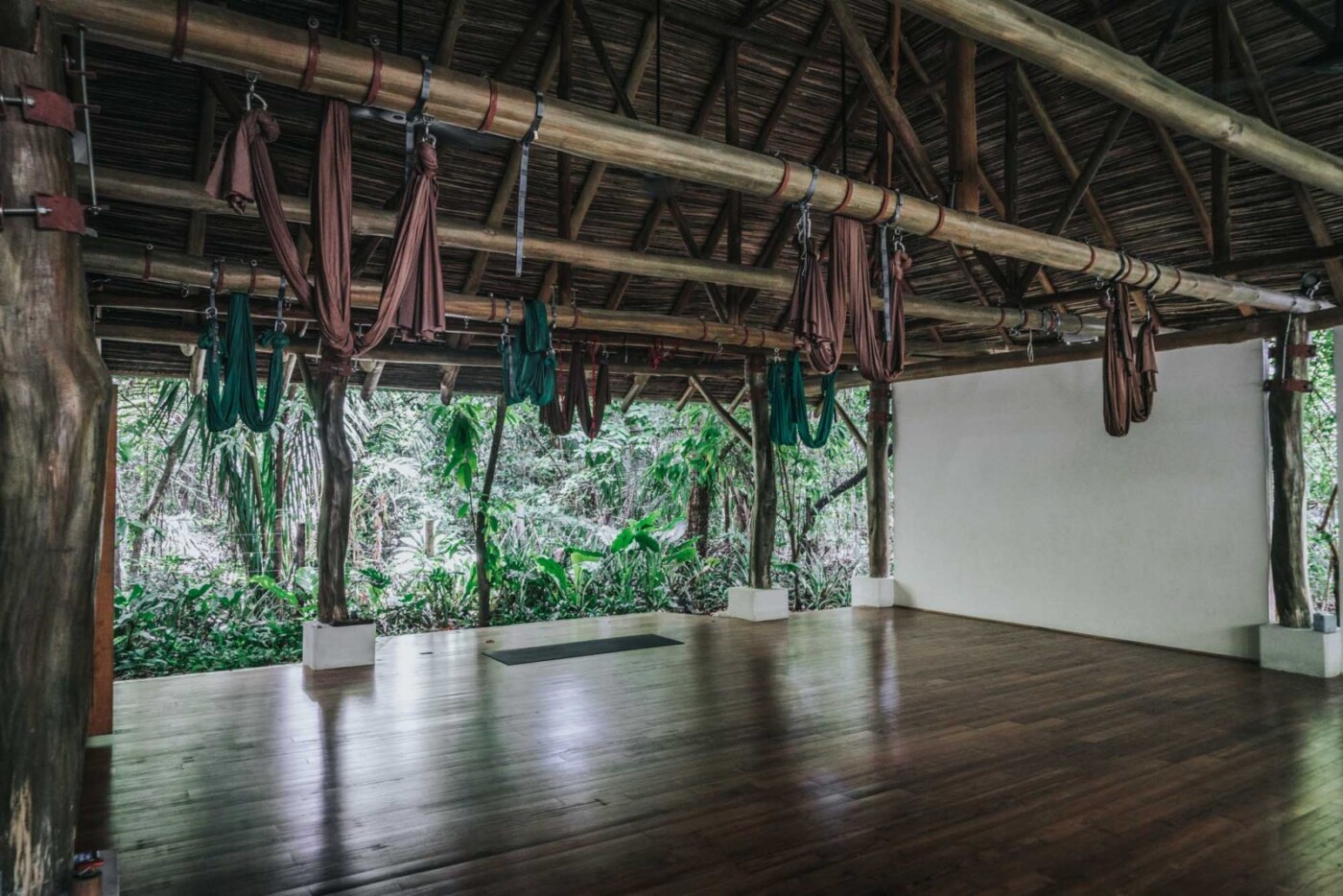


What it does well is the unglamorous part. Solar, on-site composting, a serious commitment to plastic reduction, and food sourced locally enough that the menu changes with what is available. The juice bar is a genuine institution in Nosara. If you want an eco lodge that is also a functioning holiday rather than an expedition, this is our pick.

El Sabanero, Tamarindo
Included deliberately, because everything else on this list is expensive and that is a fair criticism of the category. El Sabanero is a small, low-key property outside the Tamarindo and Avellanas area that does the fundamentals without the price tag: local ownership, low-impact building, and genuine integration with the town around it.

It will not give you a private reserve. It will give you a sustainable place to sleep for a fraction of what Lapa Rios costs, which for a lot of travellers is the more relevant comparison.
Arenas del Mar, Manuel Antonio
Arenas del Mar has the rare combination of beach access and rainforest on the same property, on the hillside above Manuel Antonio. It is CST certified, part of the same group as several of Costa Rica’s better-known sustainable properties, and it puts a meaningful amount of its land into conservation.

Manuel Antonio is the busiest national park in the country, which cuts both ways: easy to reach and correspondingly crowded. Our guide to eco hotels in Manuel Antonio covers the area in more detail if this is the region you have settled on.
Senda Monteverde, Monteverde
Monteverde is cloud forest rather than rainforest, which is a genuinely different environment: cooler, wetter, and hung with moss and bromeliads. Senda sits in a reforested corridor on the edge of it, and the property has been designed around wildlife movement rather than views.

If you have never been up here, our guide to the Monteverde cloud forest explains why it is worth the drive. Bring layers; people consistently underestimate how cold it gets.
Hotel Belmar, Monteverde
The other Monteverde option and the more established one. Belmar is family-run, has been there for decades, and has pushed harder on the operational side than almost anything else on this list: on-site biodigester, its own farm supplying the kitchen, and a carbon-neutral commitment that predates the fashion for them.

It is also a genuinely nice place to stay, which is worth saying because the two do not always coincide.
Hotel Punta Islita, Sámara
Punta Islita sits on a remote stretch of the Nicoya coast south of Sámara, and the thing that distinguishes it is the community arts project woven through the surrounding village. The hotel funded and sustains a programme that has turned Islita into an open-air museum, employing local artists.

That is the social half of sustainability, which gets far less attention than solar panels and matters at least as much. It is also one of the harder places on this list to reach, which is part of the appeal.
El Silencio Lodge & Spa, Bajos del Toro
El Silencio sits in a cloud forest valley in Bajos del Toro, a part of the country most visitors drive past entirely, with waterfalls on the property and a private reserve around it. It is the most spa-oriented option here, which is not a criticism: it is aimed at people who want the sustainability credentials and the comfort together.

Close to the Arenal region if you are building a route.
Eco Lodges in Costa Rica by Region
Region is the decision to make first, because it determines the shape of the whole trip.
| Region | What it is | Lodges here | Getting there |
|---|---|---|---|
| Osa Peninsula | The most biodiverse and remote rainforest | Lapa Rios | Flight to Puerto Jiménez, or a long drive |
| Caribbean slope | River canyon rainforest | Pacuare Lodge | By raft, or by 4×4 and a cable car |
| Monteverde | Cool, misty cloud forest | Senda, Belmar | Three to four hours from San José |
| Nicoya / Guanacaste | Dry forest and Pacific beaches | Harmony, El Sabanero, Punta Islita | Liberia airport, then drive |
| Central Pacific | Beach and national park together | Arenas del Mar | Three hours from San José |
| Central highlands | Waterfalls and cloud forest valleys | El Silencio | About two hours from San José |
What Eco Lodges in Costa Rica Cost
Rates move a long way by season and by how much of the food and guiding is included, so here is the honest shape of it. The bands in the table above translate roughly as follows.
Eco Lodge Price Bands
| $$ (from around $150 a night) | Small, locally owned, simple rooms. El Sabanero sits here |
| $$$ (roughly $250 to $450) | Well-appointed, certified, in a town or near one. Harmony, Senda, Belmar |
| $$$$ ($500 and well beyond) | Remote, all-in, private reserve. Lapa Rios, Pacuare, Punta Islita, Arenas del Mar, El Silencio |
| What pushes the price up | Remoteness, all-inclusive meals, and land held in conservation |
| Cheapest season | The green season, May to November, when rates fall sharply |
| Watch for | Whether transfers and meals are included. At the remote lodges they usually must be |
Our Costa Rica travel budget guide puts these numbers in context against the rest of a trip.
Are There All-Inclusive Eco Resorts in Costa Rica?
Yes, though the term works differently here than in Cancún. At the remote lodges, meals are included because there is nowhere else to eat: Lapa Rios, Pacuare and Punta Islita all effectively operate this way, and many include guided walks and activities as well.
What you will not find much of is the large all-inclusive resort model with sustainability attached. The two are close to structurally opposed: the genuinely low-impact properties are small, and the large resorts, whatever their certifications, are large. If all-inclusive is your requirement, the remote lodges are the honest answer.
Most of these properties are deliberately far from anything, and several require a drive of several hours or a transfer arranged by the lodge. Roads outside the main routes are rougher than visitors expect.
Check whether transfers are included before you rent anything, and take four-wheel drive for the green season.
When to Go
December to April is the dry season and the peak: reliable weather, the highest prices, and lodges that book out months ahead. May to November is the green season, when rates drop substantially, the forest is at its most alive and the rain generally arrives as an afternoon burst.
For a rainforest lodge specifically, we would take the green season without much hesitation. The wildlife is more active, the waterfalls are running, and rain in a rainforest is not a disappointment, it is the point. Our month-by-month guide to visiting Costa Rica breaks it down by region.

Frequently Asked Questions
What is the best eco lodge in Costa Rica?
Lapa Rios on the Osa Peninsula is the one most often cited and it earns the reputation, with a thousand-acre private reserve and long-standing CST certification. For a first trip with easier logistics, Harmony in Nosara is the more practical choice.
What makes a hotel an eco lodge?
Genuinely, a combination of energy and water systems, waste handling, local employment and land conservation. The clearest objective signal in Costa Rica is CST certification, which is government-run and independently assessed across four areas.
What is CST certification in Costa Rica?
The Certificado de Sostenibilidad Turística is Costa Rica’s national sustainability rating for tourism businesses, run by the tourism board and recognised by the Global Sustainable Tourism Council. Properties earn Basic or Elite level, so it is worth checking which a hotel holds rather than just whether it is certified.
Are eco lodges in Costa Rica expensive?
Many are. The best-known properties run past $500 a night and several past $1,000, largely because they are remote and hold land in conservation. There are genuinely affordable options, usually smaller owner-run lodges away from the headline destinations.
Are there all-inclusive eco resorts in Costa Rica?
A few, mostly at the remote end where including meals is practical necessity rather than a marketing choice. Lodges on the Osa Peninsula and the Caribbean slope often include food and guided activities because there is nowhere else to eat.
Do eco lodges have air conditioning and wifi?
Often not, and at the more serious properties that is deliberate. Open-air rooms with fans and nets are common, and connectivity can be limited or restricted to communal areas. Check before you book if either matters to you.
Where are the best jungle lodges in Costa Rica?
The Osa Peninsula has the most remote and biodiverse rainforest lodges, and the Caribbean slope around the Pacuare River is a close second. Monteverde offers cloud forest rather than rainforest, which is cooler and quite different.
When is the best time to stay at a Costa Rica eco lodge?
December to April is the dry season with the most reliable weather and the highest prices. The green season from May to November is cheaper, greener and better for wildlife, and at a rainforest lodge the rain is arguably the point.
Final Thoughts
The eco lodges in Costa Rica on this list are the real thing, and several of them have been doing it since before it was a category worth marketing. But the useful takeaway is not the list, it is the method: look the place up on the CST register, check the level and the date, and ask a specific question about water or power and see whether anyone can answer it.
We learned that the hard way, on the other side of the front desk. The genuinely sustainable parts of running a lodge are invisible, expensive and easy to quietly stop doing. Certification exists precisely because a guest cannot see any of it, and the properties that maintain it are telling you something about how they operate when nobody is looking. Our sustainable travel commitment sets out how we think about this more broadly, and our guide to choosing a sustainable tour operator applies the same test to the tours you book alongside the room.
Have you stayed somewhere in Costa Rica that got this right, or badly wrong? Tell us in the comments, we answer every one.

Leave a Reply