

Van awnings are the cheapest way to double the space you actually live in. Van life is synonymous with freedom and having a view of the great outdoors as your ever-changing backyard, but camper vans are not exactly bursting with room, and a few square metres of shade outside the sliding door changes how a whole trip feels. It is where the kitchen goes, where you sit out a shower, and where you eat when the inside of the van is too hot to bother with.
Awnings for campervans range from a $140 nylon teardrop that packs into a stuff sack to a $3,700 motorised European roll-out, and the gap between them is not just money. This guide covers the three form factors, what fits which van, what each type costs, and twenty specific awnings worth considering. We have run one ourselves for months of Australian outback camping, which is where most of the practical opinions below come from.
Key Takeaways
- There are three form factors and the choice is mostly about permanence. A roll-out mounts to the van and lives there, a wraparound covers far more ground but needs a rack, and a portable one packs away in a bag when you are not using it.
- Your roof height decides more than your budget does. Several popular awnings simply do not fit a high-roof Sprinter, Transit or ProMaster, and the spec sheets do not always say so plainly.
- Wraparound awnings suit anyone who cooks outside. The extra coverage lands exactly where most van builds put the kitchen, which is the back corner.
- Portable awnings have quietly got very good. They cost a fraction of a mounted awning, add no permanent weight or drag, and for occasional use they do the same job.
- Whatever you buy, the wind will decide how long it lasts. Guy it properly, drop it before you go to bed, and never pack it away wet.
Van Awnings Compared
Van Awnings at a Glance
| Price range | About $140 for a portable teardrop up to $3,700 for a motorised European roll-out |
| Three form factors | Roll-out (one side), wraparound 270 (side plus rear corner), and portable or freestanding |
| Typical setup time | Under a minute for a crank roll-out, one to three minutes for a wraparound, two to five for a portable |
| The main constraint | Roof height. Several popular awnings do not fit a high-roof Sprinter, Transit or ProMaster |
| Best all-rounder | A 270 degree rack-mounted awning, which is what most full-time van builds settle on |
| What kills them | Wind and mould. Guy it properly, drop it overnight, and never pack it away wet |
Twenty awnings worth considering, grouped by what they actually do rather than by brand. Prices are approximate and vary by size, market and whether you go manual or motorised, so treat them as bands rather than quotes.
| Awning | Type | Approx. price (USD) | Best for |
|---|---|---|---|
| MoonShade | Portable | $395 to $500 | The best portable pick and anyone without a roof rack |
| Hasika Versatility Teardrop | Portable | $140 | The cheapest way to get shade over a table |
| Yescom Car Side Awning | Roll-out, budget | $170 | Occasional shade on a tight budget |
| ARB Touring Awning | Roll-out | $230 to $400 | Lower-roof vans and the best value mounted awning |
| Front Runner Easy-Out | Roll-out | $350 | Medium-height vehicles and roof-rack builds |
| Thule OverCast | Roll-out | $420 | Lower-roof vans only, see the height warning below |
| Rhino-Rack Sunseeker | Roll-out | $350 | A simple side awning from a rack maker |
| Dometic HUB 2 REDUX | Freestanding shelter | $750 | Basecamp use where the van drives away |
| OVS Nomadic 270 LTE | Wraparound 270 | $700 to $900 | The best value wraparound, with a four-year warranty |
| Rhino-Rack Batwing | Wraparound 270 | $592 to $840 | Wraparound coverage, with a compact version for small vans |
| OzTent Foxwing 270 | Wraparound 270 | About $700 | What we ran on our own van, and still our pick |
| Darche Eclipse 270 | Wraparound 270 | About $1,000 | Wraparound coverage with add-on walls |
| 23ZERO Peregrine PRO 270 | Wraparound 270 | About $1,095 | The fastest, best-built wraparound, at a price |
| Kings | Roll-out and 270 | AUD $130 to $550 | Australian buyers wanting cheap and cheerful |
| Ridge Ryder | Roll-out | AUD $200 to $300 | Australian buyers on the tightest budget |
| XTM Car Awning | Roll-out | About AUD $200 | Small vans, Australian market |
| ROAM Adventure Co 6.5ft | Roll-out, compact | Around $500 | Small campervans that cannot take a full-size awning |
| Thule Hideaway | Roll-out, premium | $1,150 to $1,550 | A permanent, one-person roll-out that lasts |
| Fiamma F45S and F80S | Roll-out, premium | $1,050 to $1,775 | European campervans and full-time living |
| Dometic and Carefree drive-away and electric | Drive-away and electric | $600 to $1,960 | Motorhomes and anyone who wants a second room |
How to read that table
The three price tiers do different jobs. Under $500 buys shade you put up when you want it and pack away when you do not, which suits weekend and holiday use. Between $500 and $1,100 buys a wraparound that stays on the van, covers the side and the back corner, and goes up in about a 1-3 minutes, which is what most full-time van builds end up with. Above $1,100 buys a European-style roll-out with a proper cassette, wind-load engineering and often a motor, which is what you want if the van is your home and you are putting the awning out every day.
Tips on Selecting a Camper Van Awning
Six questions decide which awning is right for your van, and they are worth working through in this order.
What is the Best Type of Awning: 360 vs 270 vs 180 Degree?
These numbers describe the amount of coverage the awning will have. A 180 degree awning is your typical rectangular shape that is usually top or side-mounted onto a van. Meanwhile, a 270 degree awning is more like a three-quarter circle shape, providing outdoor space that wraps around your van. And lastly, a 360 degree awning is like a giant umbrella for your camping vehicle that provides full 360 degree coverage.
| Coverage | What it covers | Typical deploy time | Typical price |
|---|---|---|---|
| 180 degree | One side of the van | Under a minute | $140 to $1,700 |
| 270 degree | One side plus the rear corner | One to three minutes | $590 to $1,100 |
| 360 degree | The whole vehicle | Three minutes or more | $1,000 and up |
For most van builds the 270 is the sweet spot, because the wrap around the back corner covers the rear doors, which is where the kitchen usually lives. A 180 is fine if you mostly want shade over a table on one side, and a 360 is more vehicle than most campervans need.
Self-Retracting vs Manual vs Air Campervan Awnings
A self-retracting awning is usually permanently mounted and will simply slide back in with the push of a button. These are especially popular on motorhomes and RVs, and Fiamma now sells motorised versions of the F45S in the $1,700 to $2,300 range. A manual awning functions the same way but needs to be controlled by a hand crank, which is the more budget-friendly option and one less thing to fail. And alternatively, inflatable awnings are popular with drive-away awnings and work similarly to an inflatable tent.
Is it Self-Standing or Does it Need Additional Support?
Self-standing awnings for campervans do not need poles on the ground because they use guy ropes or spring-loaded tension arms for support. They are easy to set up but are often more expensive. Generally, most awnings for vans use telescopic legs and anchoring systems to create a sturdy structure. Freestanding is worth paying for if you plan to move the van during the day, because a legged awning has to come down every time you drive off.
How Do You Plan on Mounting the Awning?
Permanently mounted awnings can attach to roof racks, stock roof bars, or above your side doors. You will need heavy-duty mounting brackets and the right mounting hardware to keep it in place. Meanwhile, portable awnings can easily attach to most roof racks. Some, like the MoonShade awning, can even be mounted with suction cups or magnets, which is the answer for anyone who has no rack at all and does not want to drill a van roof. If you are still at the build stage, our Sprinter conversion build covers what actually goes into mounting hardware on a van roof.
What Type of Weather Protection Do Camper Van Awnings Offer?
Depending on the type of van awning you go for, weather protection can be an added perk. Some are UV protected, while others can hold up to high winds and heavy rain. Be realistic about wind: almost every awning failure is a wind failure, and no fabric structure bolted to the side of a van is safe in a real blow. Guy the windward side properly, drop one leg so water runs off rather than pooling, and take it down before you go to sleep if the forecast is uncertain.
How Much Do You Want to Spend?
Camper awnings often come with a hefty price tag, ranging between roughly $140 and $2,000, with the European motorised units running higher again. Figuring out your needs is important so you can establish a budget. Some fancy awning features are cool, but not always necessary. As a rough guide: under $500 for occasional shade, $500 to $1,100 for a wraparound you will use most days, and above that only if the van is your home. For context on where that sits in a whole build, see our van conversion cost breakdown.
20 Best Van Awnings and Campervan Awnings
Twenty picks, starting with the wraparound awnings that suit most van builds and working through to the portable and premium options. Where we have used something ourselves, we say so.
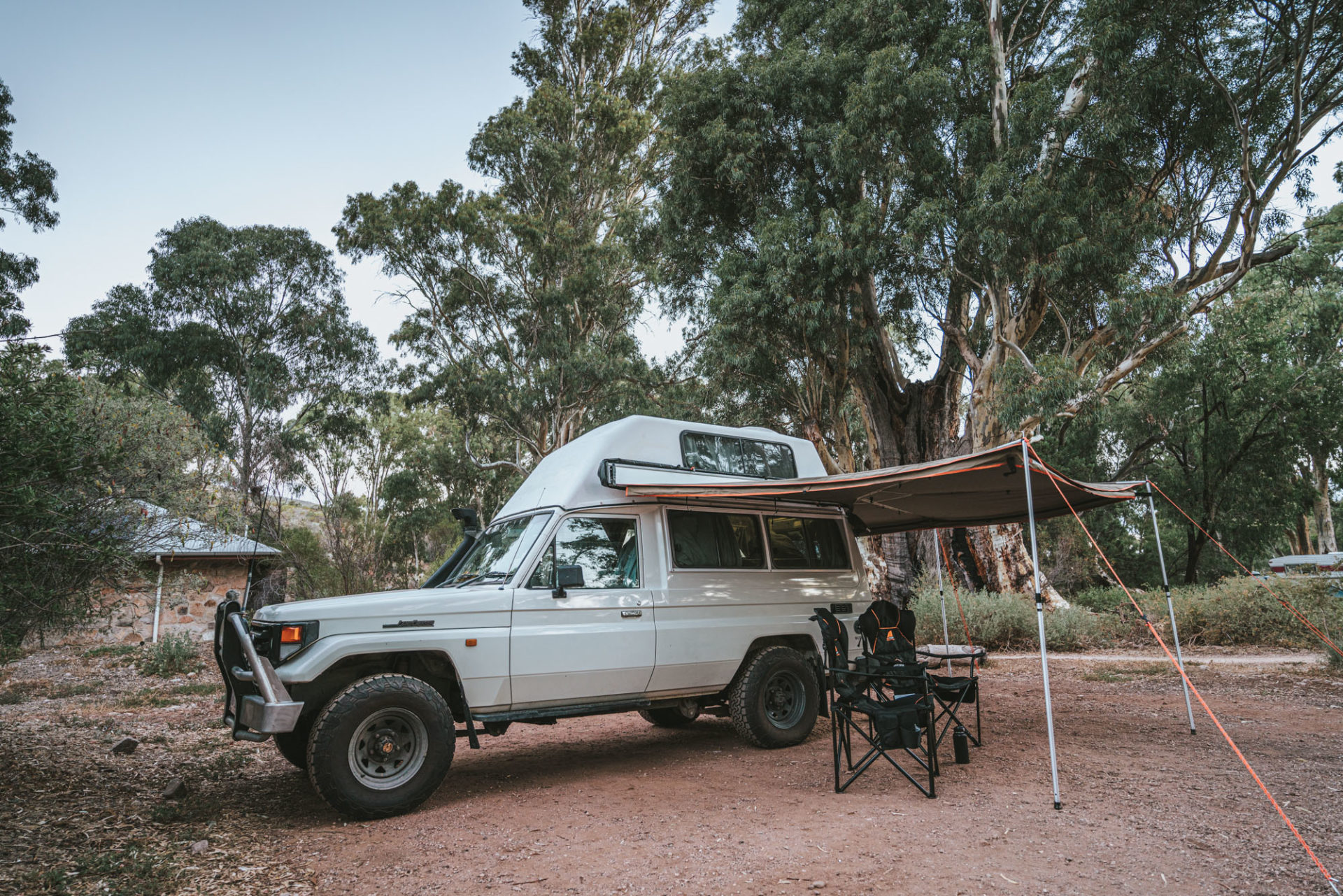
1. OzTent Foxwing 270: Best Overall, and the One We Used
These awning tents are designed to be set up by one person in less than 30 seconds. The OzTent comes in different sizes based on your campervan and how much extra room you need. Their Foxwing 270 degree awning wraps your vehicle for weatherproofing and sun protection. It is easy to set up and available in the USA and Australia for around AUD $979.

This is the awning we used on our campervan in Australia during our half-lap adventure in 2021. The setup was easy, the sun and wind protection was good, and we were overall very happy with our choice of Foxwing 270 awning. Months of Northern Territory and South Australian sun did not visibly age the fabric, and it went up and down enough times that the routine became automatic. If you want to look at it, we bought ours through this link, and the OzTent site has the current size options.

2. MoonShade: Best Portable Awning
The MoonShade is the awning that changed what a portable option can be. It weighs about eight pounds, packs into a bag the size of a camp chair, and gives roughly nine by seven feet of shade for around $395. It attaches with magnets, suction cups or brackets, which means it works on a van with no roof rack at all and comes off entirely when you do not want the drag. Outside magazine tested it as one of only two modular awnings it recommends, and every campervan awning guide we checked leads with it.
The trade-off is that it is a tent-like structure with guy lines rather than a rigid arm, so it takes a couple of minutes rather than thirty seconds, and it wants staking down. For occasional use it is the best value on this list. Details are on the MoonShade site.
3. 23ZERO Peregrine PRO 270: Best Wraparound
Easy enough for one-person setup, the Peregrine 270 Awning from 23ZERO provides 270 degree coverage. The fabric has Light Suppression Technology which helps to reduce the temperature underneath and prevent sunburn. The camper van awning can attach to your roof rack and is completely freestanding.
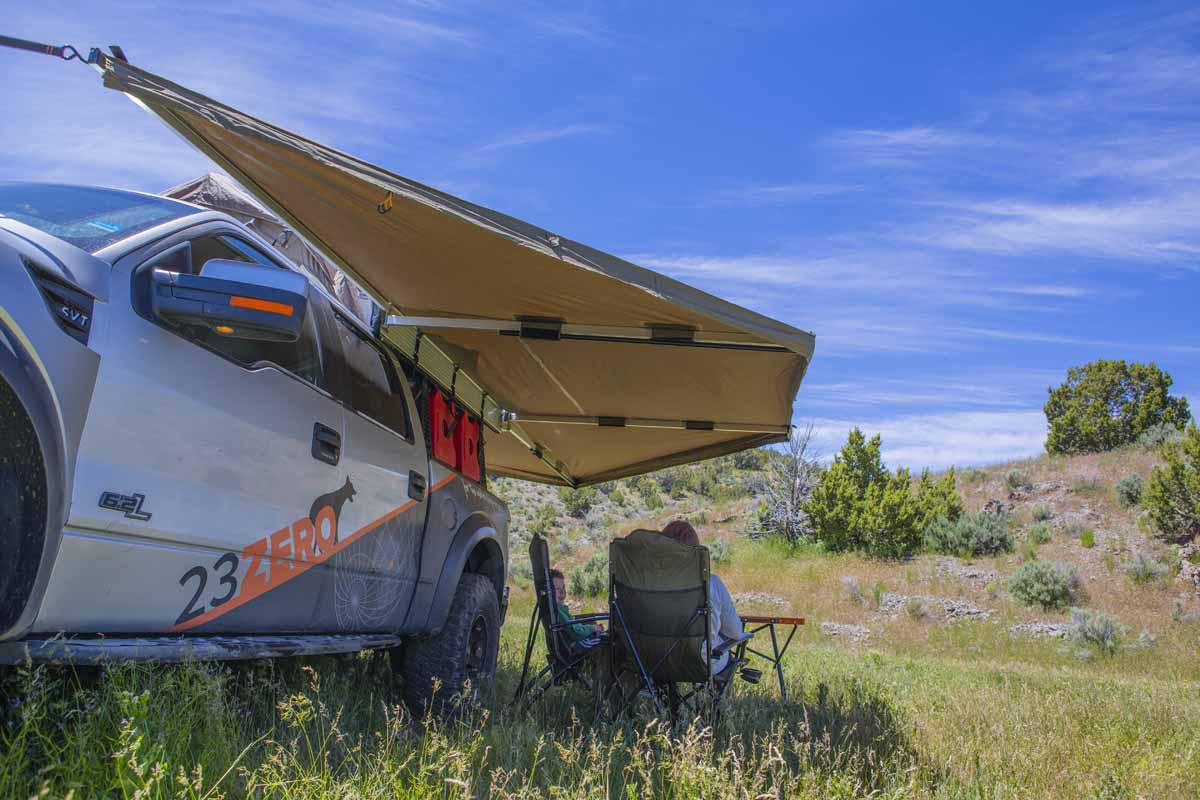
The current PRO version gives about 127 square feet of freestanding shade and deploys in under a minute, which is the fastest of any wraparound here. These features come at a price of around $1,095, and it is available in Canada, the USA and Australia through 23ZERO.

4. OVS Nomadic 270 LTE: Best Value Wraparound
Overland Vehicle Systems is the brand that has undercut the wraparound market. The Nomadic 270 LTE gives about 65 square feet of coverage in a freestanding twist-and-lock design with a four-year warranty, at the lowest price of any serious 270 on this list. There is also a Nomadic 180 with a bracket kit made specifically for mid and high-roofline vans, which solves the fitment problem that catches out so many buyers.
It is not as refined as the Peregrine and the fabric is heavier, but for anyone who wants wraparound coverage without spending four figures it is the obvious pick. See the current range at Overland Vehicle Systems.
5. Rhino-Rack Batwing and Sunseeker
Rhino-Rack side and 270 degree Batwing awnings are ready to provide shade wherever you need it. The Batwing makes for easy setup and takedown with 11 square metres, about 118 square feet, of shade covering. The legs are adjustable and the lightweight fabric is water-resistant with a UV50+ rating.
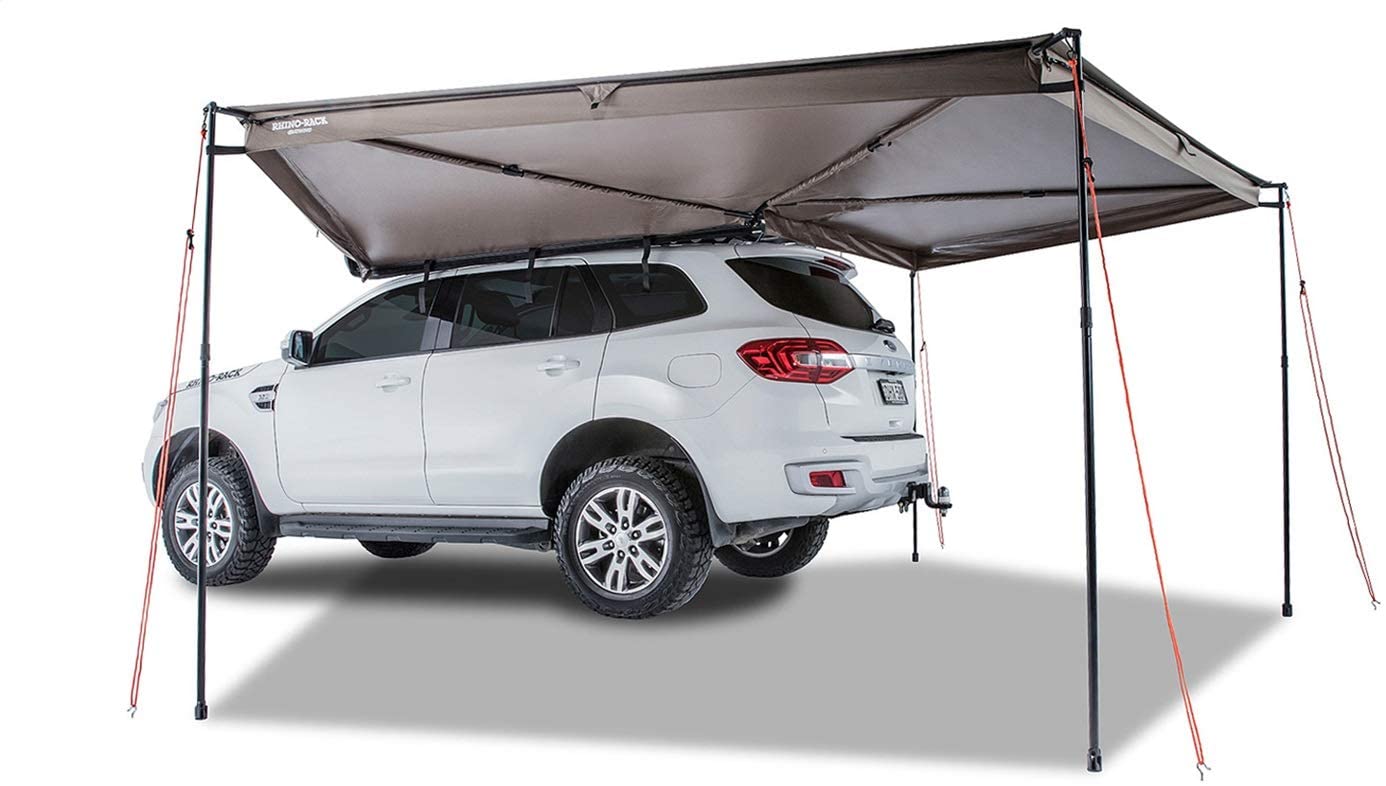
Rhino-Racks are a little pricey at around $840 for a Batwing, but you can snag a side-mounted Sunseeker for about $350. There is now also a Batwing Compact at roughly $592 that wraps nearly 69 square feet without extending past the bumpers, which is the version to look at for a shorter van. The full Batwing is on Amazon, and specifications are on the Rhino-Rack site. Rhino-Racks are available worldwide.
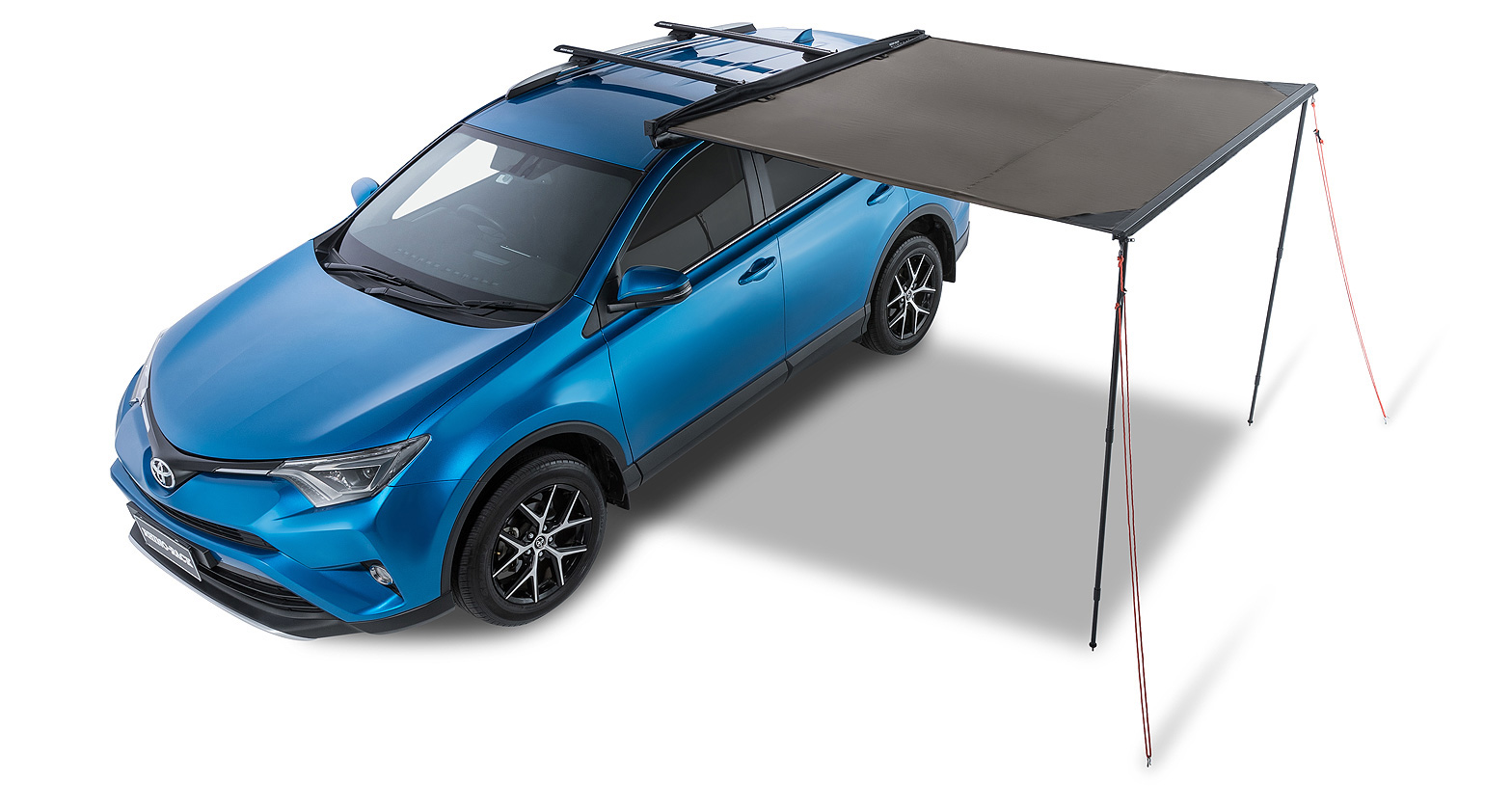
6. Darche Eclipse 270
Looking for more coverage than a regular campervan awning? The Darche Eclipse 270 Awning is good for providing shade on multiple sides of your van. It is designed to be set up by one person with three telescopic legs and guy lines. You will have shade in no time and can add additional walls to shield your living space like a tent.
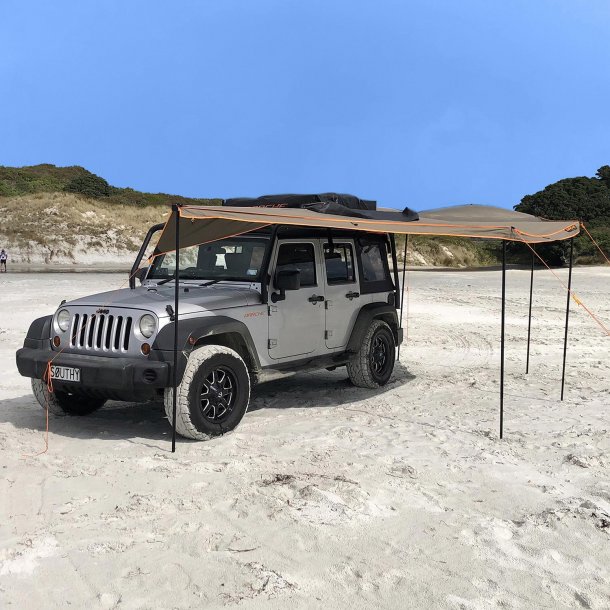
The second-generation Eclipse is stronger and lighter than the original and carries a three-year warranty. The main drawback is the price at around AUD $1,400. Darche awnings are available in Australia and New Zealand.

7. ARB Touring Awning: Best for Lower-Roof Vans
One of the better campervan awnings for smaller vans, the ARB awning is affordable and durable. It is a good retractable van awning with waterproof UV protection and adjustable height settings. It can be attached to most roof racks or bars and packs into a durable PVC bag.
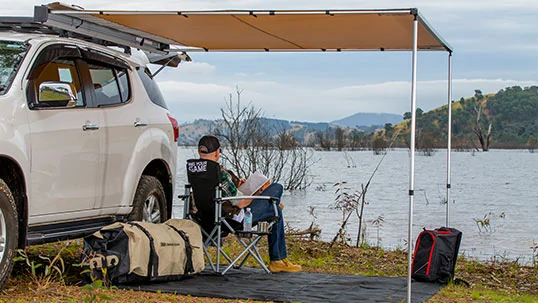
Just keep in mind that it is better for lower-roof vans since there is no hand crank. The ARB Touring Awning is around $230, or $400 with built-in LED awning lights, and is available worldwide.

8. Front Runner Easy-Out Awning
Front Runner Outfitters’ Easy-Out Awning comes in three different sizes for any medium-height vehicle. This is not your pick for a raised-roof Sprinter, but it is good for a lower roof. It mounts to your roof rack and is water repellent, UV-resistant and light.

It is not especially heavy duty and is not fully waterproof, but it costs around $350 and Front Runner ships internationally.

9. Thule Hideaway: Best Premium Roll-Out
The Thule Hideaway Awning is a manual crank awning that can be side or roof-mounted. It is easy to install and set up, even for one person. There are versions for larger vans and smaller vans and the mounting poles are built right into the unit. It is one of the better van awnings because it is light for what it is, easy to use and versatile.
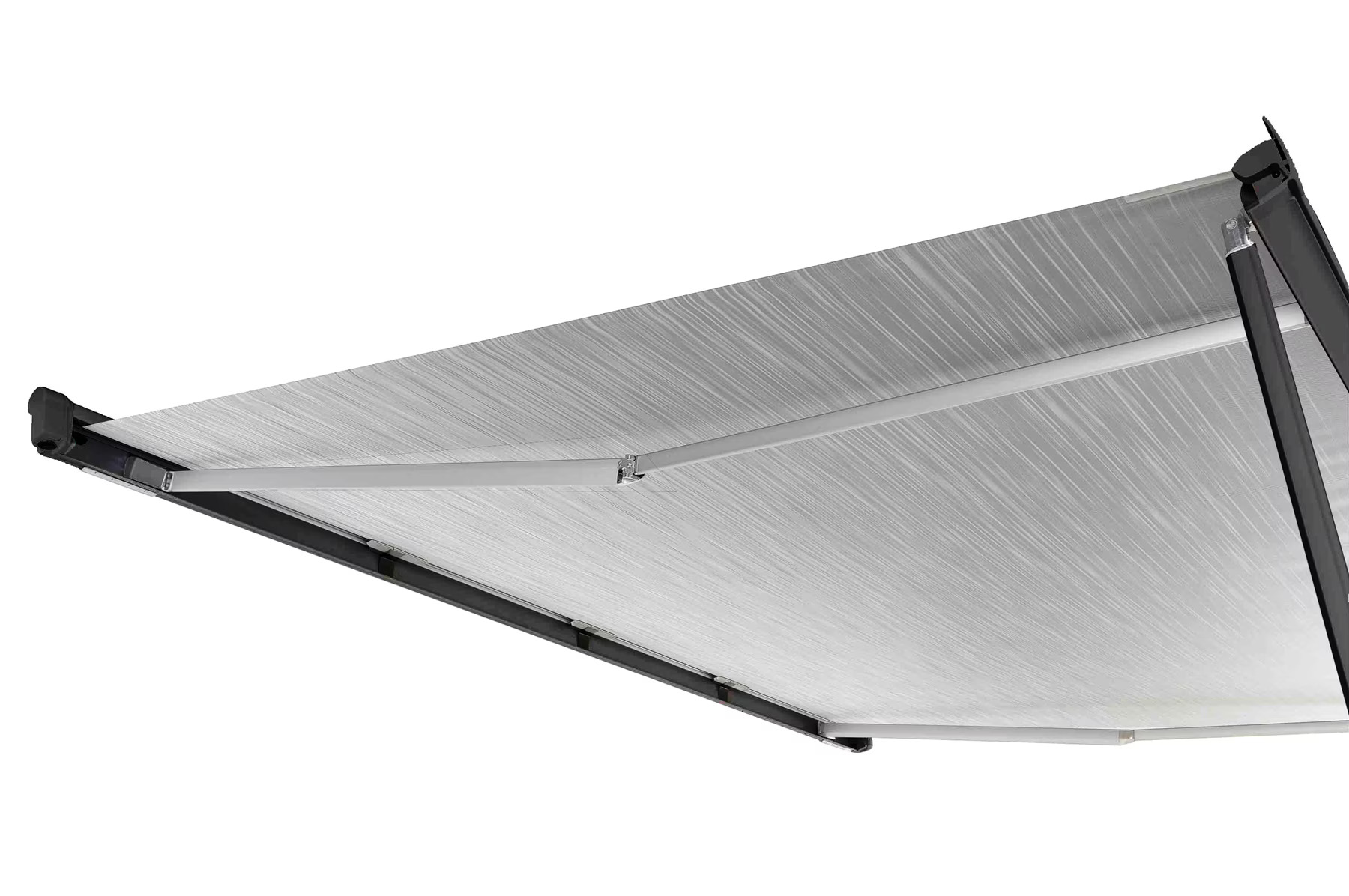
Those features come with a price tag in the $1,150 to $1,550 range depending on width, and it is available worldwide through Thule.

10. Thule OverCast: Check Your Roof Height First
The OverCast is Thule’s cheaper rollaway, at around $420 for the 4.5-foot version, and it skips the crank arm in favour of rolling back into a soft-shell cover by hand. It is a good simple option, with one very important caveat that is easy to miss on the spec sheet: it is not compatible with any model of Ford Transit, Mercedes Sprinter or Ram ProMaster, because the roof height on those vans exceeds its maximum installation height of about 6.5 feet.
In other words, the three most common campervan platforms in North America are all excluded. If you are on a lower-roof van or a wagon it is worth a look, and if you are not, buy something else.
11. Fiamma F45S and F80S: Best for Full-Time Living
Fiamma makes compact lightweight awnings for camper vans that are durable and convenient. In particular, the Fiamma F45s has shock-absorbing brackets to withstand the wind and built-in LED lights. It has a UV-stabilised cover that is waterproof and easy to roll in with a manual winch. Like other awnings, it is not exactly cheap but has features that justify the $1,050 to $1,750 price.
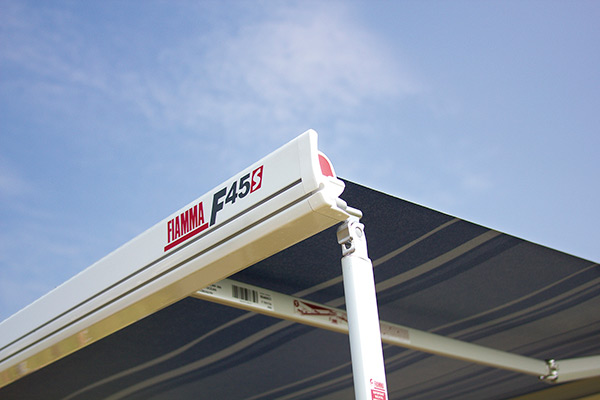
Fiamma has since added the F80S, a more compact and streamlined case designed specifically for campervans rather than motorhomes, at roughly $1,420 to $1,775, and the larger F65 Eagle for motorhomes at $3,400 and up. Motorised versions of the F45S run $1,700 to $2,300. If you are living in the van and putting the awning out daily, this is the family to look at.

12. Dometic Drive-Away Awnings
Dometic RV awnings are popular options for drive-away awnings with inner tents. The Rally Air Pro 330 provides a lot of extra room that can double your interior space. The campervan awning tent is inflatable for easy setup and made from weather-resistant fabric. It is not the cheapest model at around $1,960, but a Dometic awning is something you can get worldwide. Dometic also makes the PerfectWall and PerfectRoof roll-out awnings if you want a mounted unit rather than a drive-away room.
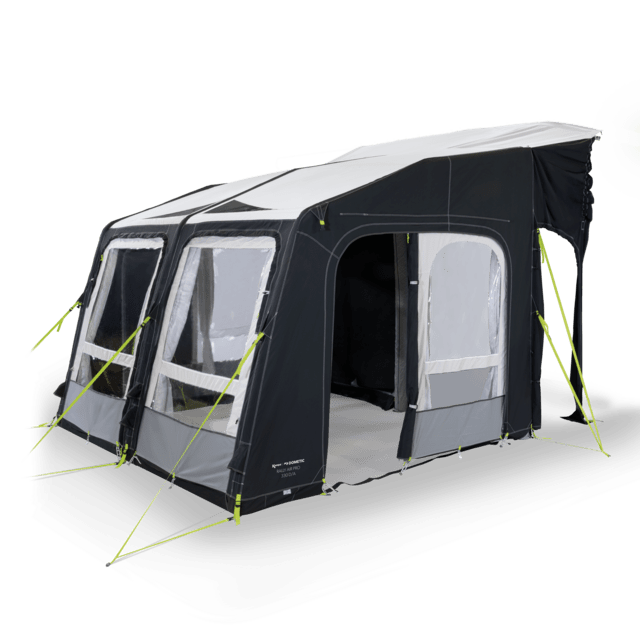
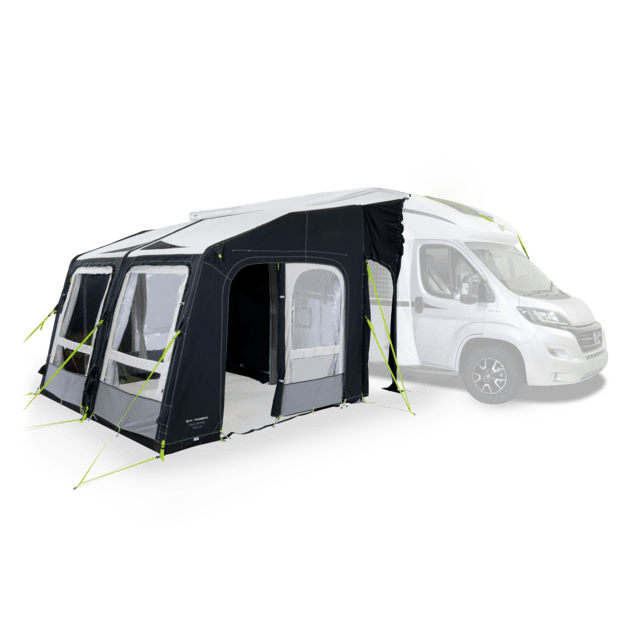
13. Dometic HUB 2 REDUX: Best Freestanding Shelter
The HUB 2 REDUX is not strictly an awning at all, which is the point. It is a freestanding inflatable shelter of about seven and a half feet square that weighs around 19 pounds and costs roughly $750. Because it stands on its own, the van can drive away and leave it pitched, which is exactly what you want if you are basecamped somewhere for a few days and still need to go and get water.
Outside tested it alongside the MoonShade as one of the two modular options worth owning. It is bulkier to store than a rolled awning and slower to pitch, and in exchange you get a structure that does not depend on the van being there.
14. Hasika Versatility Teardrop Awning: Best Budget Pick
If you are looking for an affordable awning for van conversions, the Hasika Versatility Teardrop Awning is a good option. It fits any size van and easily attaches with guy lines and adjustable poles. The teardrop-shaped van canopy creates enough space for a table and chairs that is protected from rain and sun.
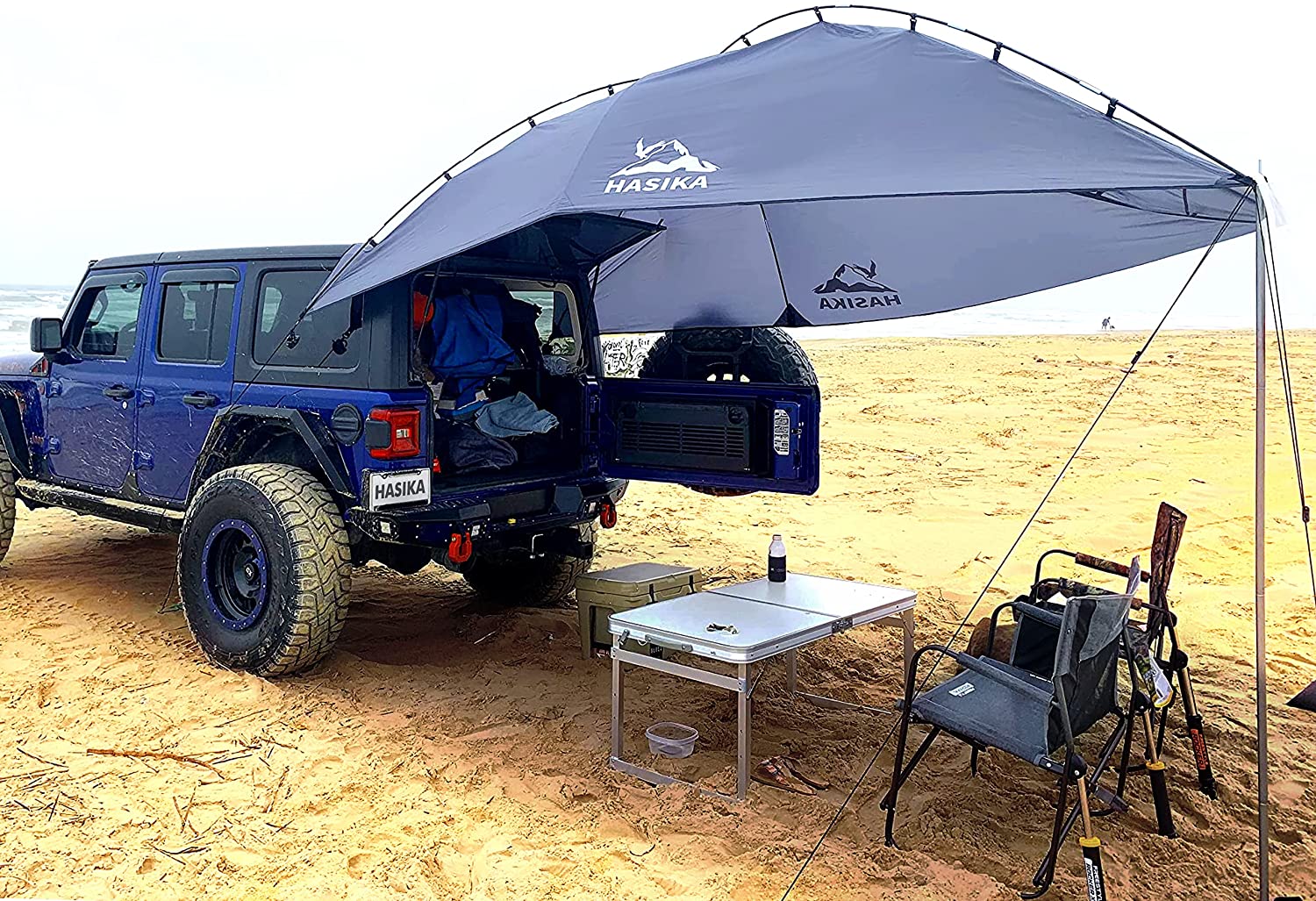
While it is much cheaper at around $140, it is less durable than others but still a solid portable option readily available on Amazon.

15. Yescom Car Side Vehicle Awning
An affordable option for your van life budget is the Yescom Awning. It is easy to install on any vehicle or campervan and is made from water-resistant UV-protected fabric. The poles easily twist to extend and lock in place with guy ropes.

For a price of around $170, it is expectedly not the most durable but still fine for extra shade on occasional trips.

16. ROAM Adventure Co 6.5ft: Best for Small Campervans
The ROAM 6.5-foot rooftop awning is built for small campervans that need reliable shade without adding bulk. Its compact size gives enough coverage for cooking, sitting out of the sun or getting out of a shower, and it does not overhang a short wheelbase van the way a full-size awning does. It sits in the $500 range and is a sensible answer for a Transit Connect, a Metris or a converted minivan. See current sizes at ROAM Adventure Co.
17. Kings
If you are in Australia, Kings makes a range of motorhome awnings and awning tents for campervans. They are just as easy to set up as they are to pack away and work with any sturdy roof rack. The fabric is UV-protected, waterproof and light for Australian conditions. Prices range from about AUD $130 to $550 for a 270 degree wrap awning.
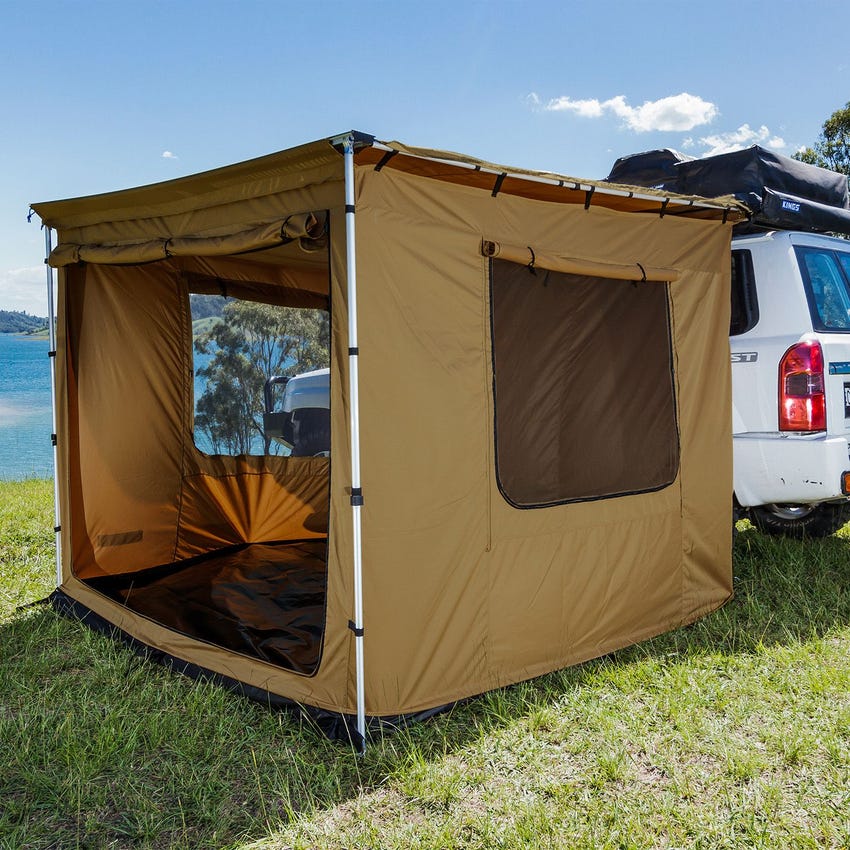
These are cheap and cheerful rather than heirloom gear, and they are hard to beat on price if you are buying in Australia. Availability outside Australia is limited.

18. Ridge Ryder
Another Australian pick, Ridge Ryder makes affordable awnings for van conversions, SUVs and truck campers. They are easy to set up on your roof rack or bars and are light. The fabric is waterproof but does not have a UV coating for hotter days. It is also not as heavy duty as others, but you can pick one up for around AUD $200 to $300. Australian availability only.


19. XTM Car Awning
XTM makes awnings for campervans very similar to Kings and Ridge Ryder models. They are made from UV weather-resistant fabric that mounts onto your roof rack with L brackets. They pack easily into the PVC storage bag so you can leave it mounted when you are not using it.

Just like the other two, they are not the most durable, but they offer a compact option, especially for small vans. XTM awnings are available in Australia for around AUD $200.

20. Carefree Electric Awnings
A Carefree RV awning is a luxurious choice for a campervan canopy. Carefree makes a line of electric awnings that mount to the side or roof of your motorhome or campervan. They are the easiest to operate since a 12V electric motor does all the work, but they are more geared for RVs. They are made from vinyl fabric, which is much heavier than the lightweight nylon used on conversion van awnings. Prices run about $600 to $1,500 depending on size and features.
We ran the OzTent Foxwing 270 on our Troopy through an Australian half-lap, and it is still what we would buy.
Around AUD $979, one-person setup in under a minute, freestanding, and available in Australia and the USA.
Best Awning for a Sprinter Van, Transit, ProMaster and High-Top Campervan
This is where most awning purchases go wrong. Roof height, not budget, is the constraint that rules options out, and the taller the van the fewer awnings physically fit. Here is the short version by platform.
Best Awning for a Sprinter Van
A high-roof Sprinter is too tall for the Thule OverCast and awkward for the Front Runner Easy-Out, both of which are designed around lower vehicles. Go for a rack-mounted wraparound instead: the OzTent Foxwing 270, the OVS Nomadic 270 LTE or the 23ZERO Peregrine PRO all mount high and clear the roofline without trouble. If you want a permanent cassette rather than a wraparound, the Fiamma F80S is the one designed for tall campervans. Our Sprinter van conversions gallery shows how these sit on a finished build.
Best Awning for a Ford Transit
The same height rule applies to a high-roof Transit, and the OverCast is explicitly not compatible with any Transit model. A 270 on a rack is the reliable answer, and the OVS Nomadic 180 with the mid and high-roofline bracket kit exists precisely for this fitment problem. For a low-roof Transit or a Transit Connect, the ARB Touring and ROAM 6.5ft both work well.
Best Awning for a Ram ProMaster
The ProMaster’s boxy roofline is the easiest of the three to mount a wraparound on, and again the OverCast is out on height. A Batwing, Foxwing or Nomadic 270 all sit cleanly on a ProMaster rack. Watch total width if you have a full-width rack already, since a 270 needs clearance to swing.
Best Awning for a High-Top Campervan or Small Van
For a pop-top or a converted minivan, the constraint flips: the awning is often too big rather than the van too tall. The ROAM 6.5ft, the ARB Touring and the Rhino-Rack Batwing Compact are all sized for shorter vehicles. And if you have no roof rack at all, the MoonShade is the only one on this list that genuinely does not need one.
How to Build a DIY Van Awning
If you would rather not spend hundreds of dollars, a workable awning is not complicated. The basic recipe is a woven shade sail or tarp, two adjustable tent poles, guy lines and pegs, and a way to attach the fixed edge to the van. On a van with a roof rack, that attachment is usually a length of bungee or shock cord threaded through the sail eyelets and around the rack bar, which lets the whole thing move in a gust rather than tearing.
Two things matter more than the materials. The first is shock absorption: a rigid attachment concentrates every gust into one grommet, and a bungee or shock cord spreads it. The second is pitch, meaning you drop one side lower than the other so rain runs off instead of pooling, because a pool of water will bring down a homemade awning faster than wind will. Budget roughly $100 for the parts, and expect it to be a two-minute setup rather than a thirty-second one.
This is a genuinely good option for a first van or a short trip, and it is how a lot of people find out what size and shape they actually want before spending real money. Our campervan hacks guide has more in this vein, and the DIY elevator bed build is the same approach applied inside the van.
Fitting, Cleaning and Repairing a Van Awning
Awnings fail for boring reasons, and almost all of them are avoidable. Fitting first: a mounted awning wants to be bolted to a roof rack or a proper set of brackets, not to sheet metal. Check the awning’s weight against your rack’s dynamic load rating, not just its static one, because the load while driving is what matters. Mount it on the side you will actually camp on, which for most people is the sliding-door side.
Mould is the most common way an awning dies. Never pack it away wet, and if you have to, get it out and dried within a day. Clean it with mild soap and water and a soft brush, never a pressure washer and never a detergent with bleach in it, both of which strip the waterproof coating. Rinse the salt off after a coastal trip.
Small tears are fixable and worth fixing early. A repair patch on both sides of the fabric will hold a tear indefinitely; left alone, the same tear will run the length of a panel in one windy night. Check the hinges, arms and fittings for corrosion once a season, particularly if you camp near the coast. And on wind, the rule that saves awnings is simple: if you would not leave a tent pitched in it, do not leave the awning out in it.
Frequently Asked Questions
Can you sleep in a campervan awning?
No, camper van awnings are meant to be mounted to your van like an extra roof. Consider a van awning tent or a drive-away awning with an inner tent if you are looking for a sleeping solution.
How do awnings fit to campervans?
First, you will need to choose the right size awning based on the length and height of your van. Then it can be mounted to the side of your campervan or roof rack, or set up temporarily with poles and guy lines.
Are drive-away awnings any good?
A drive-away awning is a good way to add extra floor space that is sturdy and protected from the elements. They are useful for detaching and leaving in place for the day so you can go and explore without having to re-assemble.
How much does a campervan awning cost?
Portable awnings such as the MoonShade start around $395, and the Hasika teardrop is around $140. Rack-mounted 270 degree awnings run roughly $590 to $1,100, and permanently mounted retractable awnings from Fiamma and Thule run $1,050 to $3,700 depending on width and whether the model is motorised.
Do you need a roof rack to fit a van awning?
Most 270 degree awnings mount to a roof rack or a set of rack bars, but side-wall bracket kits exist for Fiamma and Thule models, and portable awnings such as the MoonShade attach with magnets, suction cups or brackets and need no rack at all.
Are 270 degree awnings worth it?
For anyone cooking or working outside the van they usually are, because the wrap around the rear corner covers the area most van builds use as a kitchen. For occasional weekend use a 180 or a portable awning does the same job for less money and less weight.
Can you leave a van awning out in the rain?
Light rain is fine on a pitched awning, as long as you drop one side so the water runs off rather than pooling. It should come down in wind, and it should never be packed away wet, since trapped moisture is the main cause of mould on awning fabric.
How long does it take to set up a van awning?
Most 270 degree awnings deploy in one to three minutes, and freestanding models can be set up by one person in about a minute. Retractable side awnings crank out in under a minute. A portable awning with guy lines takes two to five minutes.
What is the best awning for a Sprinter van?
A rack-mounted 270 such as the OzTent Foxwing, OVS Nomadic 270 LTE or 23ZERO Peregrine PRO, or the Fiamma F80S if you want a permanent cassette. Avoid the Thule OverCast, which does not fit a high-roof Sprinter.
Final Thoughts
After months of living under one, the thing we would tell anyone shopping for a van awning is that the cheapest mistake is buying too much awning. A 270 that takes a minute to deploy gets used every single day. A complicated setup that takes ten minutes gets left rolled up, and an awning you do not put out is worth nothing regardless of what it cost. Match it to your roof height, guy it properly, and dry it before you pack it.
If you are still building the van itself, our guides to campervan accessories, van life essentials, camper van insulation, campervan fridges, campervan solar panels, portable toilets and campervan coffee makers cover the rest of the kit. If you have not chosen a van yet, start with the conversion companies or read about our own Australian road trip. What is your take on awnings for campervans, and would you go permanent or drive-away?
READ NEXT: How To Choose The Best Van For Camper Conversion
Some links in this guide are affiliate links, including Amazon links. If you buy through them we may earn a small commission at no extra cost to you. We only recommend gear we would use ourselves, and the Foxwing 270 is the awning we actually ran on our own van.


Leave a Reply